Housing Doesn't Need More Noise. It Needs Less Friction
Spain needs more homes, but it also needs a faster, more effective way to make them happen. While the public debate becomes increasingly polarised, companies, professionals and institutions are already working to transform a sector that needs to evolve.
Spain is in the middle of an intense debate about housing. We talk about rents, holiday rentals, second homes, taxes and access to housing. These are legitimate discussions, but they risk turning a deeply human challenge — finding a stable place to live — into another ideological battleground.
At Caos, we believe that beyond the debate over who should pay more or less, we need to address one of the fundamental imbalances in the housing market: Spain is not building enough homes in the places where new households are being formed.
This is not simply a question of left or right. It is about our collective ability to respond to a basic need in a timely, sensible and coordinated way.
If we know we need more homes, why is it still so difficult to build them?
A Supply Problem, Not Just a Price Problem
According to CaixaBank Research, around 1.2 million new households were formed in Spain between 2021 and 2025, while approximately 474,000 homes were completed. This represents an estimated cumulative housing shortfall of at least 734,000 homes.
When housing supply consistently fails to keep pace with demand, prices come under pressure, access becomes increasingly difficult and the divide grows between those who already own a home and those trying to find one.
But the consequences go far beyond economics.
Young people delay moving out on their own. Families struggle to find the space they need. People are forced to leave the places where they have built their lives.
The housing crisis is also a crisis of independence, opportunity and the freedom to plan our lives.
The Bottleneck Is in the Process
On paper, Spain has land designated for future development. Yet many planned residential developments remain unbuilt for years.
Having land designated for housing, however, is not the same as having land ready for construction.
Between identifying a potential development site and delivering a finished home lies a complex chain of processes: urban planning, permits, financing, technical projects and construction.
Add to this a shortage of skilled labour, rising construction costs and a sector that still relies heavily on developing each project through processes that are difficult to replicate.
Sociologist Jorge Galindo, director of EsadeEcPol and author of Tres millones de viviendas (Three Million Homes), has placed the mismatch between household formation and new housing construction at the centre of his analysis of Spain's housing crisis.
This is not about building at any cost or compromising urban, environmental or architectural quality.
It is about questioning whether the way we plan, approve and develop housing is equipped to respond to the scale of the challenge.
Because being able to manufacture a home in a matter of months means little if getting permission to build it takes years of uncertainty.
Less Ideology, More Practical Solutions
Housing requires political decisions, but progress should not depend on permanent confrontation between opposing positions.
Faster and clearer planning procedures. Updating outdated urban plans. Increasing the availability of land ready for development. Expanding social housing. Providing greater legal certainty for owners and tenants. Making renovation easier.
None of these measures can solve the problem alone. But disagreement over one should not prevent progress on the others.
We need better coordination between public administrations, clearer processes and greater predictability for the people and organisations responsible for investing, designing and building.
Innovation in housing doesn't begin when construction starts. It begins much earlier, when we make it possible for a project to move forward.
The Transformation Is Already Underway. The Challenge Is to Connect It.
It would be unfair to suggest that no one is working to change the way we build.
The Spanish Government has recognised the importance of this challenge through the PERTE for the Industrialisation of Housing, approved in 2025 to support the modernisation of the sector and increase its production capacity.
But transformation doesn't begin or end in the factory.
Companies such as VisualUrb are working to make urban planning information more accessible and support better decisions about land and regulations.
The Spanish Association for Industrialised Construction (AECI) promotes collaboration between companies and professionals to develop new construction and production models.
The CSCAE 2030 Observatory addresses challenges related to housing accessibility, architectural quality and the transformation of the built environment.
And events such as REBUILD demonstrate how industrialisation and innovation have become central topics for professionals across the construction industry.
These initiatives approach the challenge from different perspectives. And that is precisely why they matter.
The talent is there. The technology is there. So is the ambition to transform the sector. The challenge is connecting these capabilities and turning them into homes that actually reach people.
From One-Off Projects to Building Systems
For decades, much of residential construction has been organised around individual projects, each requiring the coordination of numerous professionals, suppliers and decisions.
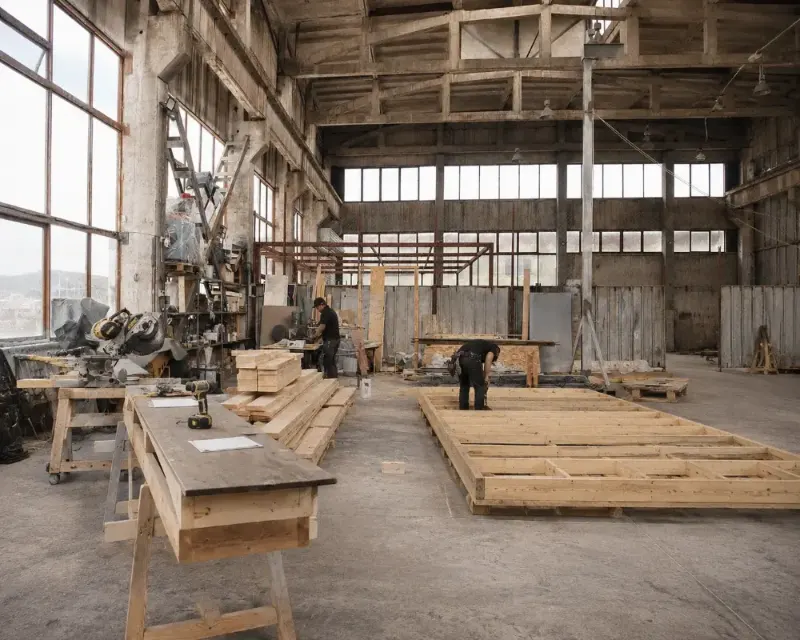
Industrialised construction offers a different approach to part of this challenge: moving more work into controlled manufacturing environments, developing predefined solutions and reducing certain activities on site.
But there is an important distinction between industrialising how an individual project is built and designing housing as a repeatable system of products.
Standardisation allows engineering to be developed in advance, materials to be defined, processes to be controlled and costs and timelines to become more predictable.
This doesn't mean every home has to look the same, or that every project can be solved through a catalogue.
It means recognising that creating a well-designed space doesn't always require starting from scratch.
If we need to build more homes, we should also be asking how much of today's work could be designed, developed and coordinated before each individual project begins.
Caos: Rethinking How We Design, Build and Live
At Caos Modular Homes, we started with a question that goes beyond construction.
Why do we continue to approach so many spaces as entirely individual projects? Could we simplify the way they are produced without compromising design, quality or the feeling of having a place of our own?
Our vision is clear:
We believe in adaptable spaces, simpler processes and homes that feel like your own.
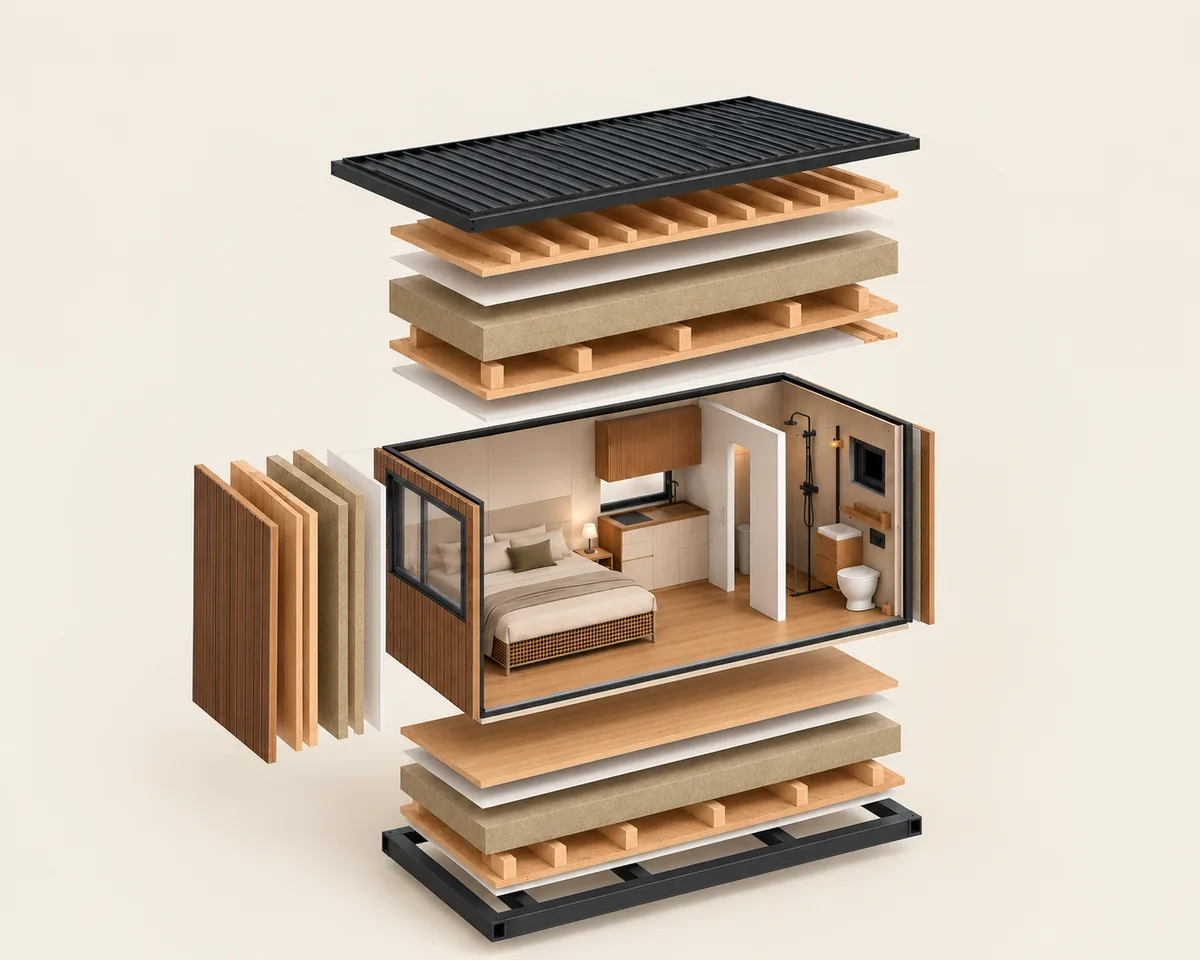
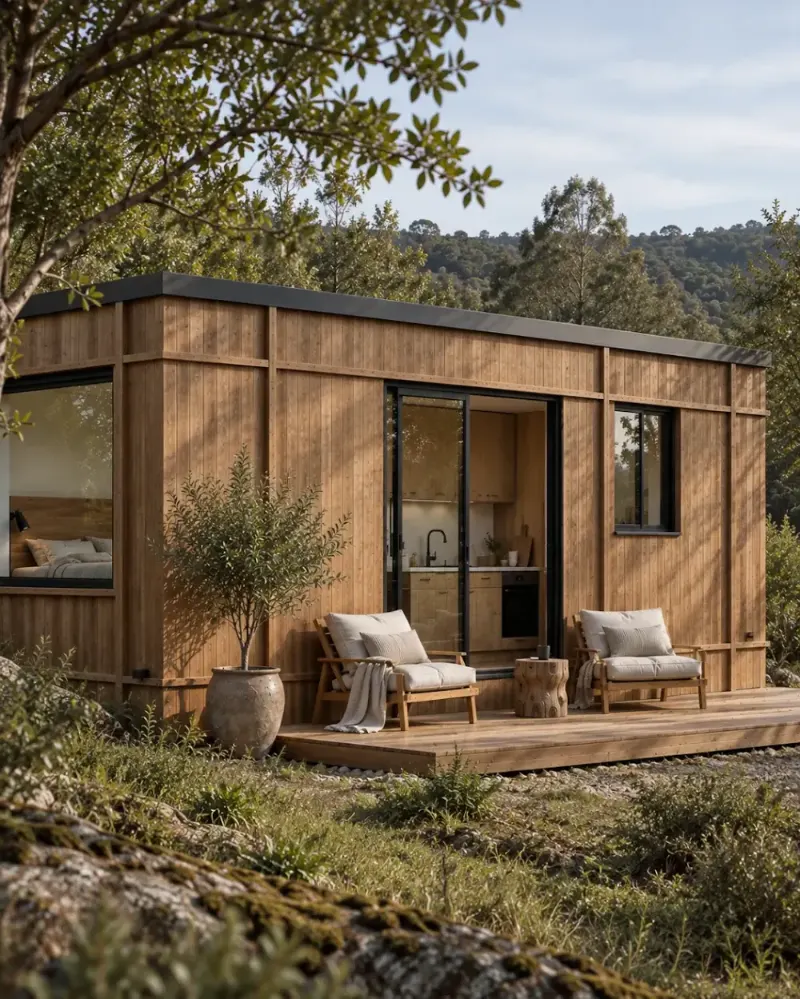
We develop a system of standardised modules, with predefined construction solutions, that allows different configurations and carefully selected options for materials and finishes.
Our model is also based on decentralised manufacturing, working with a network of specialised workshops rather than relying on a single factory of our own.
We recognise that modular construction doesn't eliminate planning requirements, doesn't automatically make housing affordable and isn't suitable for every project.
Nor do we claim that Caos alone can solve Spain's housing shortage.
But we do believe we can contribute to a necessary shift: moving away from treating every space as a project that starts from scratch and towards developing systems that can respond to different needs more efficiently.
And that shift isn't only technical. It's also about how we want to live.
A Home Is Not a Slogan
Behind every housing statistic is someone delaying their independence, a family struggling to find enough space or a person forced to leave the city they call home.
Housing should be something that brings us together, not another source of division.
Real progress won't be measured by who wins the public debate, but by our ability to shorten the distance between needing a home and actually being able to have one.
To achieve that, we need to question established processes, improve collaboration across the sector and create space for new approaches.
There is no single answer to the housing crisis. But there is a shared responsibility to ensure that our ability to create places to live keeps pace with the needs of society.
At Caos, we want to be part of that change.
Because redefining the way we live isn't just about living in a different space. It's about having the freedom to choose how we want to live.
And for that freedom to become a reality, we also need to rethink how we make homes possible.