Modular vs. Prefabricated Homes: What's the Difference?
If you're researching modular homes, you've probably also come across the term prefabricated homes, or prefab homes. The two are often presented as different types of housing, but are they really?
The short answer is that modular homes built in a factory are prefabricated, but not every prefabricated home is built using complete modules.
The terms are closely related, but they don't describe exactly the same construction method. Here's why.
First, What Makes a Home Prefabricated?
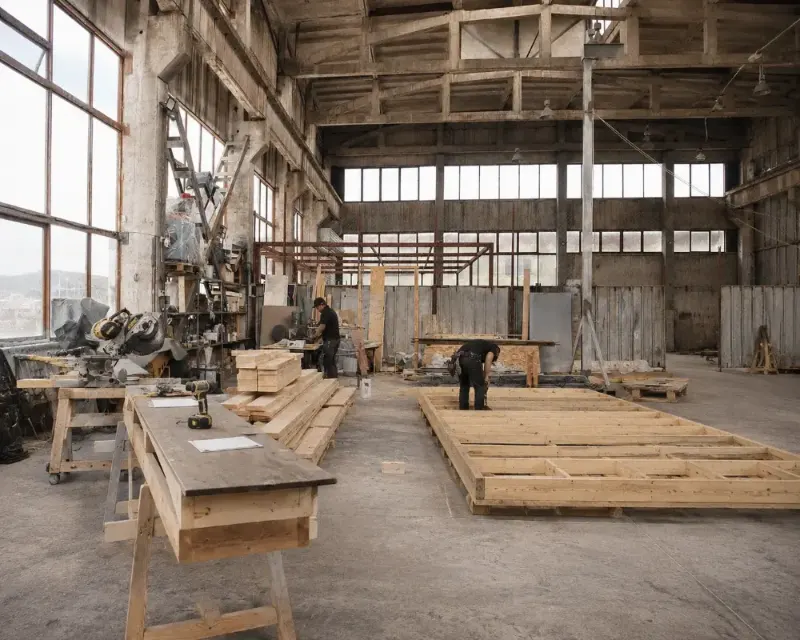
A prefabricated home is one in which part of the construction process takes place away from its final location, usually in a workshop or factory.
Rather than building everything from scratch on site, certain elements are manufactured in advance and then transported to the plot for assembly or installation.
But these elements can take very different forms.
For example, one manufacturer might produce the walls and roof panels of a house and assemble them on site. Another might manufacture an entire room, complete with windows, building services and interior finishes, before transporting it to its destination.
Both approaches use prefabrication, but the construction process is different.
So, What Is a Modular Home?
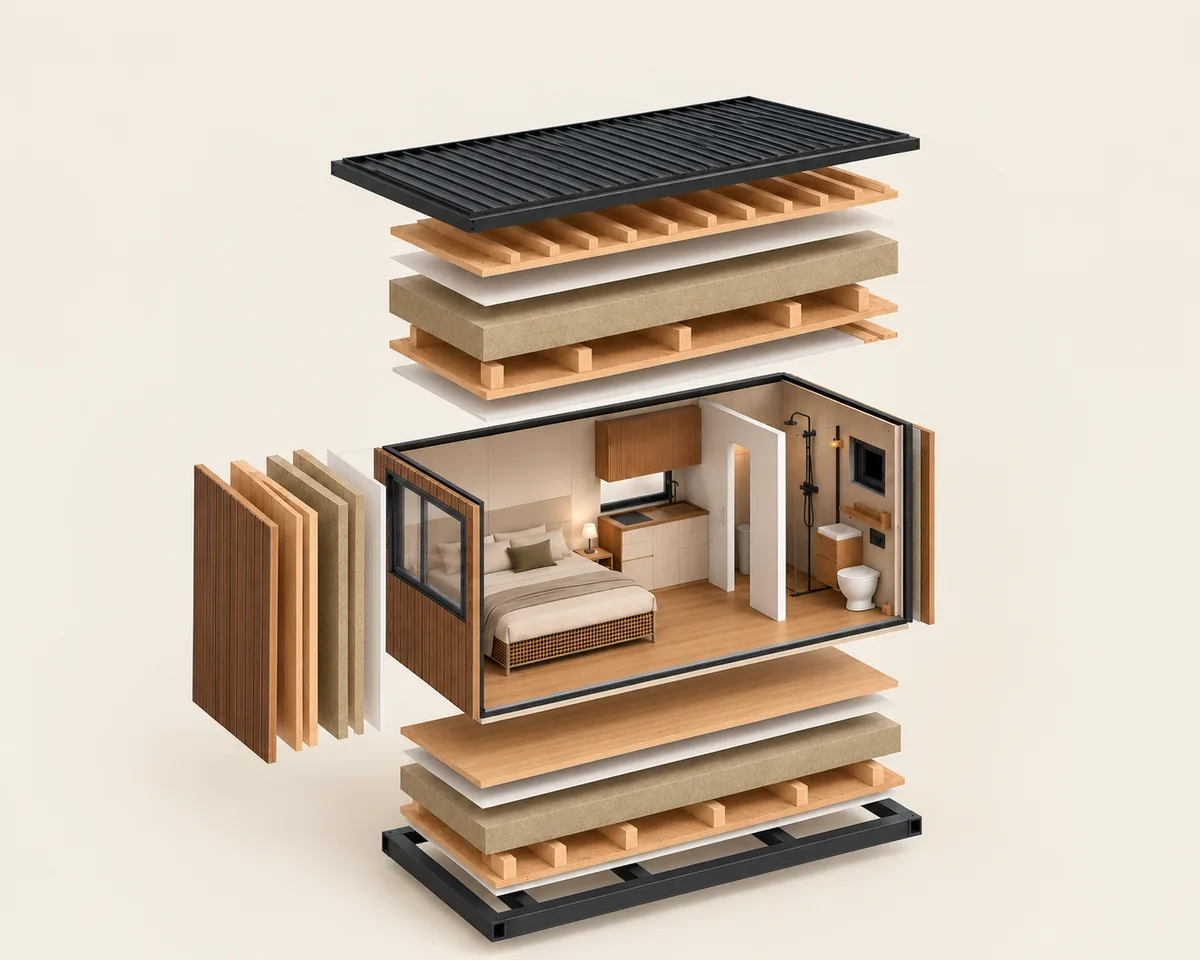
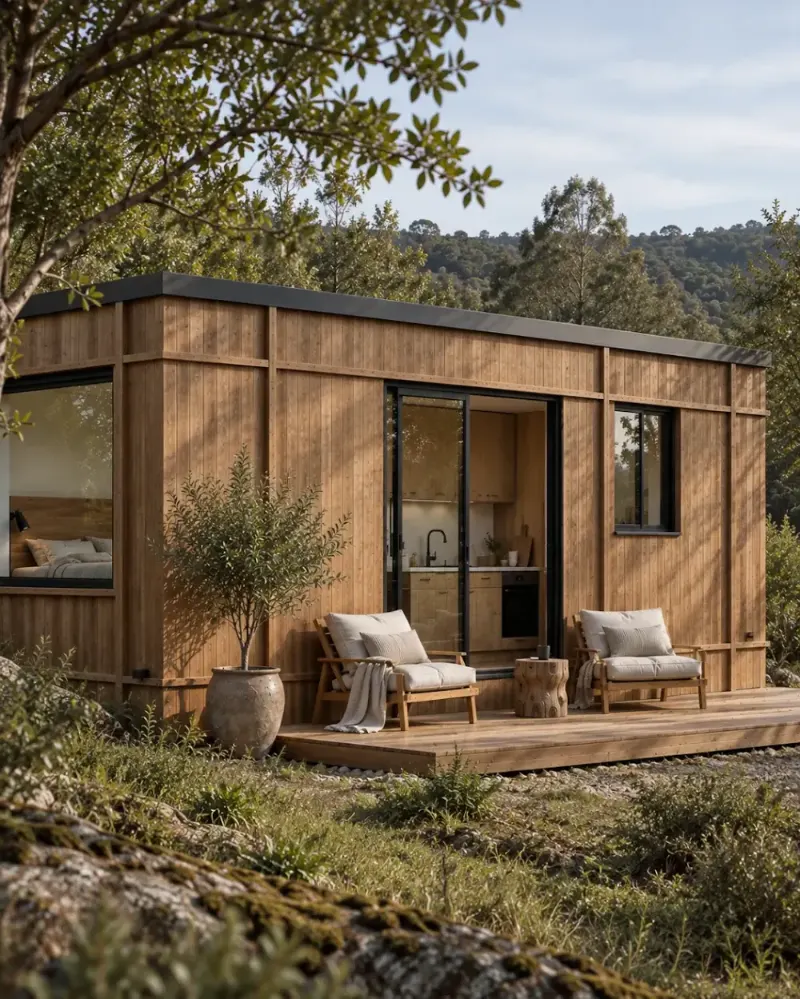
In the type of modular construction we use at Caos, a home is made from complete three-dimensional spaces manufactured off-site.
These modules incorporate a floor, walls and roof, and may also include windows, building services, cladding, a kitchen or a bathroom.
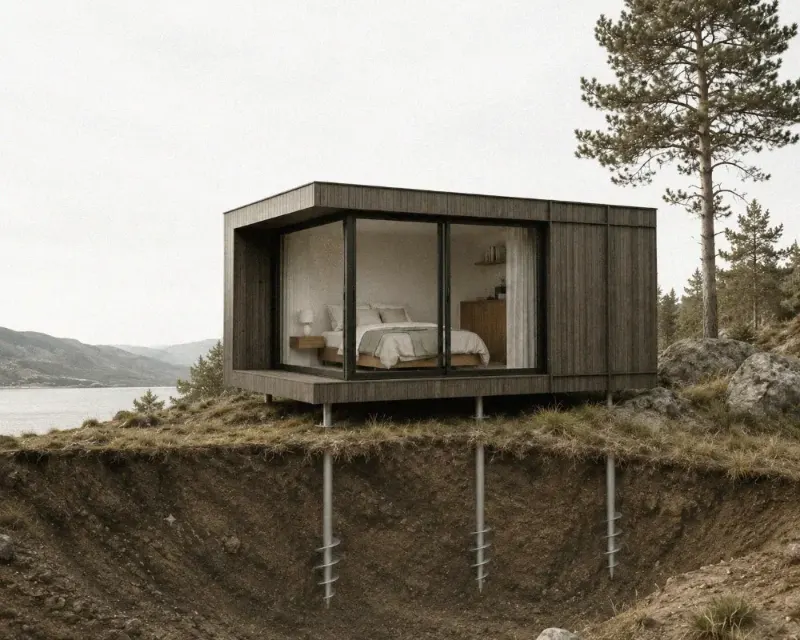
Once manufactured, they are transported to the site and installed on prepared foundations.
Some homes consist of a single module, while others combine several modules to create larger living spaces, provided the construction system has been designed for this.
The main difference compared with homes built using prefabricated panels is that what arrives on site isn't simply a collection of building components, but complete spaces with much of the construction work already finished.
An Example Makes It Clearer
Imagine you want to build a 60 m² home.
Option 1. A Prefabricated Home Built with Panels
The manufacturer produces the walls, roof panels and other building components in a workshop.
These elements are then transported to the plot and assembled to form the house. Once the structure is in place, any remaining work is completed on site, such as building services, cladding or interior finishes.
Option 2. A Modular Home Built from Complete Modules
The manufacturer could, for example, produce two 30 m² modules in a workshop, provided the construction system and transport conditions allow it.
Each module may arrive with windows, building services, interior finishes and some of the equipment already installed.
Once on site, the modules are positioned on their foundations, connected to each other and to the necessary utilities, and any remaining work is completed.
Both approaches involve prefabrication. The main difference is what gets manufactured and transported: individual building components or complete three-dimensional spaces.
What Changes in Practice?
What arrives on site
Prefabricated Homes (Panels): Walls, roof panels and other components
Modular Homes (Complete Modules): Complete three-dimensional modules
Work on site
Prefabricated Homes (Panels): Assembly of components and finishing work
Modular Homes (Complete Modules): Positioning, joining modules and connecting utilities
Transport
Prefabricated Homes (Panels): Individual elements transported separately
Modular Homes (Complete Modules): Larger, complete modules
Design
Prefabricated Homes (Panels): Can accommodate a wider range of shapes and dimensions
Modular Homes (Complete Modules): Defined by the modular system and transport limitations
Finishes
Prefabricated Homes (Panels): Some work may be completed on site
Modular Homes (Complete Modules): Modules can arrive largely or fully finished
These differences are intended as a general guide. Each manufacturer may work with different levels of prefabrication and completion.
Does That Make Modular Construction Better Than Panel-Based Construction?
Not necessarily.
Modular construction using complete modules can be particularly useful when the aim is to reduce assembly and finishing work on site. Manufacturing most of the space in a workshop makes it easier to plan certain stages and work in a more controlled environment.
However, transporting complete modules also comes with limitations. Their dimensions and weight affect logistics, site access and the equipment required for installation.
Panel-based construction, on the other hand, can offer greater flexibility for certain designs or sites with restricted access, although it generally involves more assembly work on site.
Neither approach is automatically cheaper or faster. The outcome depends on the project, the level of prefabrication, transport requirements and the work that still needs to be carried out on the plot.
What Type of Construction Do We Use at Caos?
At Caos Modular Homes, we work with complete, three-dimensional modules manufactured off-site.
We design standardised modules that are fully manufactured and fitted out in a workshop before being transported to their final location.
Some models, such as Capsule and Open Studio, function as independent spaces. Others are designed to be combined to create larger homes.
Working with a defined catalogue allows us to establish dimensions, layouts, materials and construction details in advance, while offering a carefully selected range of customisation options.
It also means we don't design every home from scratch or freely adapt module dimensions to each individual project.
Our aim is to move as much of the construction process as possible into the workshop and simplify the work required on site, while recognising that foundations, utility connections, permits and site preparation are still necessary.
What Should You Check Before Choosing a Modular or Prefabricated Home?
Whether a manufacturer uses the term modular or prefabricated, what matters is understanding how its construction system actually works.
Before making a decision, find out which parts of the home are manufactured off-site, how complete the building will be when it arrives, what work remains to be done and what is included in the quoted price.
It's also essential to check whether the system is suitable for your plot and whether it meets your requirements in terms of space, design and intended use.
Modular and prefabricated construction are not opposing concepts. Building with complete modules is one approach to prefabrication. The difference lies in how the home is built and how complete it is when it reaches its final location.